Saturday, January 28, 2012

Riding with the Wind

One time a couple years ago, we had a really windy afternoon when I visited the barn to work with Harley.  I had decided days ahead of time that I wanted to lunge that particular day.  When the barn owner saw me lungeing my horse, she said that she was really glad that I was not riding him.  I wondered why.  I have ridden Harley on windy days and he is the same as he is on non-windy days.  If the wind is dangerously high, then we don't ride because inclement weather is not safe under the best circumstances, but on a regular day that happens to be windy, I usually stick to my plans to ride.

I know that some riders use an indoor on windy days, but I do not have access to one.  I am not sure if I understand the rational for riding in an indoor on really windy days anyway, because the creaking and knocking sounds of the building bracing against the wind is probably worse than just riding outdoors.  I guess you do avoid dust or debris being blown around; that part makes sense.

Harley is not a "leaf" meaning that he doesn't get frantic just because the wind is blowing, but he isn't an uninspirable creature either.  When I took him out to ride yesterday, a very windy day, his legs and belly were already splattered with mud.  Thinking out loud, I asked him what he had been up to.  The nice young lady working in the barn said that he had been "cantering all over the place" while she was out cleaning the paddocks.  Oh, so Harley does like to run around in the wind.  He was also pretty bright-eyed and electric in the cross-ties.  He looked like a horse who was feeling really good and ready for anything.  Did I mention that he has gained weight?  (Happiness!)

For a split second, I thought about not riding.  The wind was pretty high, almost borderline as far as safe riding conditions go, but I hadn't ridden all week and I just needed to be in the saddle.  From the looks of Harley, he was itching for some action too and clearly had plenty of energy to burn.  Then I remembered that I do not change my riding plans, because the wind is blowing.  Harley is a horse, not a leaf!

So we went out and we rode.  Harley's mane whipped up and fell on the opposite side of his neck, giving him a very romantic, salon-treated look.  Even though the wind was blowing, I still needed to use leg to encourage him to be forward and carry himself through the transitions.  He gave me some nice, long and low stretchy trot with plenty of push from behind.  On long reins, he felt like he was gliding around the ring.  He was smooth and easy.  Not once did I worry about him suddenly scooting to the side, bolting or losing his mind.  Ironically, when we did canter, he was less apt to jump around and try to change leads for fun then he did on windless days.  Interesting.  We also did several canter to trot transition with me remaining in sitting trot.  His back stayed up and it wasn't until later that I realized I had stayed seated through the transitions.  I think we are making progress.  Rushing into the trot and anticipating the next canter is not his knee-jerk reaction anymore.

On our last canter circuit, I felt that he wanted to drop behind my seat (an indication that he wanted to try to change), so I projected with my upper body more (not back though!) and kept my legs on and my seat firmly closed in the saddle.  Harley cantered a few strides that were downright magical.  His forehand came up a lot and I could almost see his front legs articulating in slow motion during the increased hang time.  We transitioned to a very balanced, very easy trot with a huge "Good Boy, Harley!"

As we cantered down the long side, Harley's mane whipped up and I had to close my eyes for a few strides to avoid the gusts.  I know that horses can get excited in the wind.  It was windy for the last trail ride that I went on and two horses who were normally Steady-Eddies bucked and got hyped up.  Harley did prance a little, but kept his feet on the floor and clearly he has no qualms about charging around his paddock when the wind is blowing.  I think that it is different when I am in the saddle.  I like to think that it means he trusts me, I trust him, and he wants to keep me on board.  I know that this type of trust, with an enormous animal, should always be combined with a healthy dose of caution and reality.  Things can and do go wrong.  My friend broke her ankle on that windy trail ride, because her usually quiet trail horse decided to pop his butt a few too many times.  Really, once is too many.

But for me and Harley, riding with the wind can be a blast.


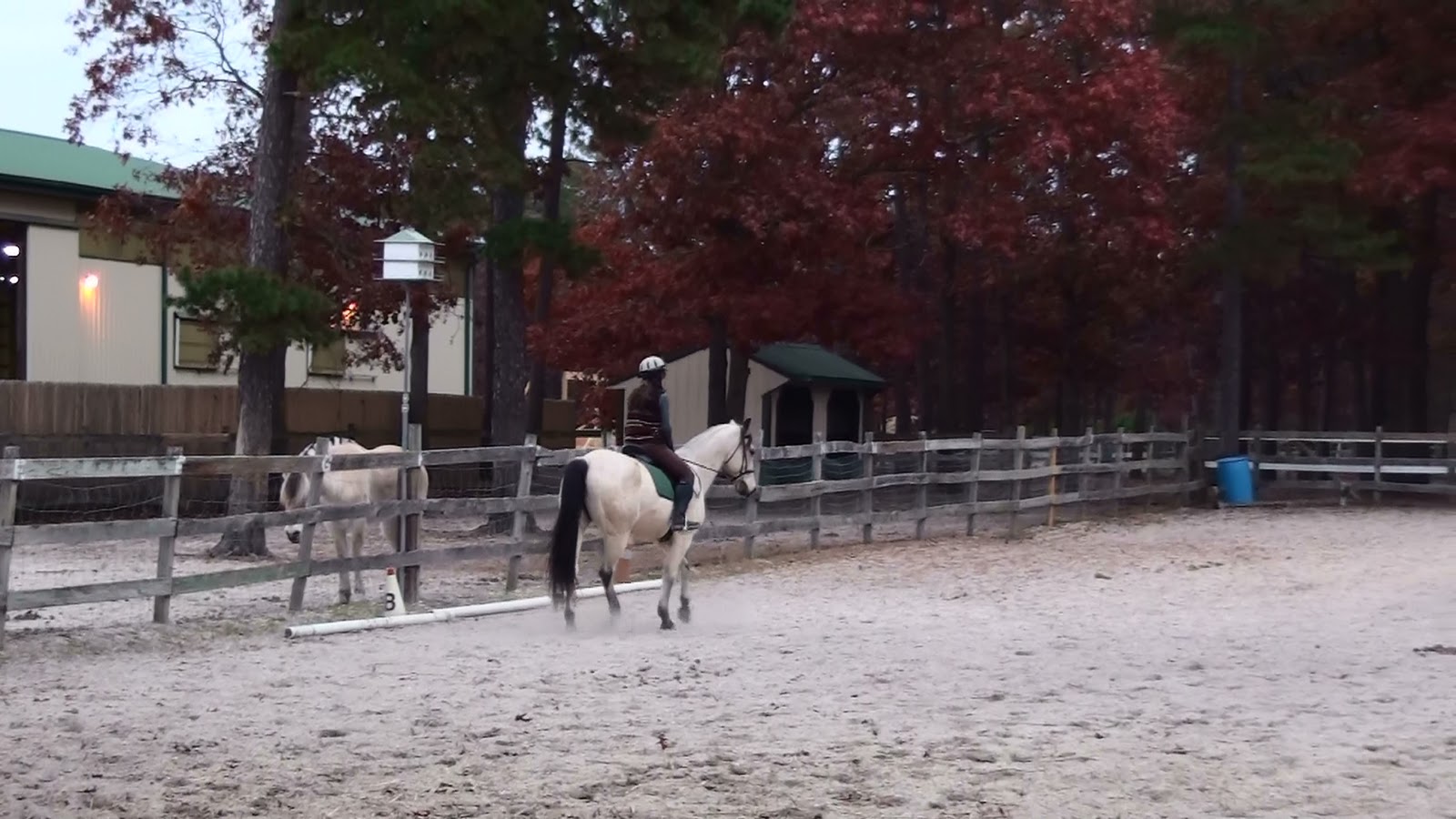
Photos from a fun day in October.

Thursday, January 26, 2012

Riding Reflection: One-Handed Riding and the Forward Surge

There is a little thing that I like to do once in a while.  I like to ride our warm-up trot-work with one hand.  Sometimes I let the reins get really long and literally hold the buckle to see where Harley wants to put his head.  Years ago, Harley would choose to carry himself like a giraffe.  In other words, he didn't carry himself.  Now that he has learned to stretch, a long rein is an invitation to lengthen his neck.  If he is really in the mood, sometimes he stretches his neck all the way down to the ground like a peanut-pusher.  He will do this under saddle and on the lunge line, but I don't expect this much stretch at a horse show.  I know that it is really not the kind of stretch that a dressage judge is looking for and Harley is always a little too keyed up to really let go like that at a horse show, even a small, local one.  He is much more fun to ride at home.

Other times, I use one-handed riding to test our connection and my own steadiness and correctness.   Once we have a nice forward trot and Harley is reaching through his back and neck into the bit, I carefully place both reins in one hand, usually the inside hand. 

The benefits are numerous...

Riding with one hand makes it very easy to ensure that my reins are even and that my horse is going to each side of the bit equally. 

Riding with one hand prevents me from raising one hand or fussing with one side of the bit instead of just riding Harley forward from my seat and legs. 

Riding with one hand shows me if my horse is not engaging one hind leg as much or is bracing with one shoulder, be it stiffness or unequal aiding on my part.

Riding with one hand tells me if I am riding Harley straight and forward.

Riding with one hand leaves my free hand available to gently encourage with the whip, keep rhythm, or make positional corrections such as feeling for softness in my lower back or checking that my bellybutton is pushing back toward my spine.

Riding with one hand makes it basically impossible to "cheat" with my hands.  All of the aids must work in concert for Harley to carry himself and reach for the bit.  When everything fits together and the puzzle is complete, even if it is only for a few strides, the feeling is very validating.  After lots of practice, we can basically go all around the ring with little change in his frame or balance.  This makes me happy!

Riding with one hand gives my horse the opportunity to show his level of understanding without corrections from the hand.  This makes Harley happy!

Switching from one-handed to two-handed riding is also a useful coordination exercise.  Harley was moving forward really nicely after a few minutes of one-handed riding and switching between the two.  I like to put the reins in my inside hand so that I can still ask for inside flexion with my ring fingers.  I initiate a circle this way and use my weight and legs to turn him.  It is fun to ride different sized circles with just my body.

When we change direction across the diagonal, I slowly change to two-handed and then put my reins in the new inside hand.  I use my free hand to tap with the whip if he not forward enough and adjust the rein length in my holding hand.  Harley's neck gets really long and gorgeous when we ride this way.  Sometimes I experiment with shortening his stride and then asking him to go back to working trot.  Riding with one hand requires that I continue to ask him to go forward from my legs and seat even as he is shortening or collecting his trot.  If I do just use my hand, then he hollows or backs off the contact.  Riding with one hand keeps me really honest and gives me a lot of information about what I am doing and how I am doing it.  Since I see my teacher very infrequently, this is a valuable self-evaluation tool.

A new thing to do this year would be to translate some of this to the canter.  We have not done as much work with one-hand in the canter partly because his canter has not been as rideable as it is now and partly because I don't usually think to do it.  This would be a good challenge and will, no doubt, show me some interesting things.  I already know that Harley will like it very much.

After our one-handed warm up, I was really feeling the forward surge under my saddle.  Harley's hind legs were pedaling underneath me with a pleasant, assertive feel.  I tested the feeling by sitting the trot.  He continued to push the saddle and my seat along.  It felt very easy to sit this way and I felt very still.  Sometimes we lost the feeling, but the change was very subtle.  He would start to rush down the long side or tighten in anticipation of the canter (which I was not going to ask for yet).  The feeling under the saddle changed before the tempo of his trot or tension became visible in his back.  If I felt the surge disappear, he was sure to change his tempo and balance immediately afterward.  Even though the trot probably didn't look that different, it became much less easy to sit and much less comfortable.  I found myself starting to tip forward and collapse.  It also felt like he was pulling the reins from me instead of pushing into the reins.  The difference in feel was dramatic.  The first sensation was steady yet powerful, the second was strong but unstable.  I believe that this was my horse swapping from "back to front" to "front to back" movement and thinking.  It was very interesting. 

I found that I had the best luck encouraging him to stay in the former when my seat gave little nudges in coordination with my legs.  If I just used my legs, he didn't really improve and adjusting my hands didn't work either.  Harley seemed to best understand what I wanted from him when I used my seat.  I began playing around with keeping him in front of my seat literally with little forward nudges.  I also had to keep my seat closed in the saddle.  I kept contact with the saddle and tried to support my upper body without leaning forward or back.  If I lean back, he hollows and flattens onto the forehand.  If I lean forward, he cannot carry himself properly and falls onto the forehand.  There is not much grey area, which makes it very challenging, but when I achieve the correct position he rewards me instantly.  When Harley moves this way we can do anything.  Canter depart.  Shoulder-in.  Half-pass.  It is just a matter of when and where and a flick of the ear.

Shoulder-in right

Harley-style

Tuesday, January 24, 2012

Riding Reflection: Mutual-Over-Achiever-Thought-Process

Yes!  A few warm days and some rain has softened the arena enough for a ride.  I thought that we would just take it easy, warm up and stretch, and basically we did, except that some mutual over-achiever-thought-process got us moving a little more than I planned.  Let me explain by giving you a taste of our inner dialogue.  Just in case you are taking me seriously, no one can actually hear all the details of our conversation (except for us, of course).

Me: We are just going to walk and trot today, Harley.  You haven't worked in a while.

Harley: Okay, but look how nicely I can stretch in trot.

Me: That is nice, Harley!  If you pushed your trot out and took a little bit bigger strides, you would look like those horses stretching in the classical dressage YouTube videos.

Harley: Like this?

Me: Yeah!  That's awesome.  Can you go all the way around the ring like that?

Harley: Yup.  And I can change direction.  Watch.

Me: That was some great trot work, Harley.  A really nice stretch, especially because we haven't worked in a while.  We better leave it at that.

Harley: Yeah, but I'm not really tired.

Me: Let me check your breathing.  You do look good.  We shouldn't canter though.  Let's take it easy.

Harley: Didn't the barn owner just turn on the lights?

Me: Oh yeah.  I kind of feel obligated to stay out here a little longer now.

Harley: We could canter a little (ear flicks back).

Me: We better not.

Harley: Maybe just once around.

Me: Just one circle, that's it.

Harley: Cantering is my favorite!  Watch me flying change!

Me: Harley, we are not doing that right now.  Now we have to canter another circle, but this time nicely.

Harley: Let me change.  I want to.  Stop blocking me.

Me: No.  Go back to trot.  Hey, good job keeping your back up in the transition.

Harley: I could show you again if we canter?

Me: Okay, but no more trying to change.

Harley: Okay, I promise (ear flicks again).

Me: Great....Harley!

Is it possible to have too much fun riding your horse?  We did actually do some productive things that I would like to reflect upon, but this riding reflection has gone silly.  Oh well, this is supposed to the off-season!